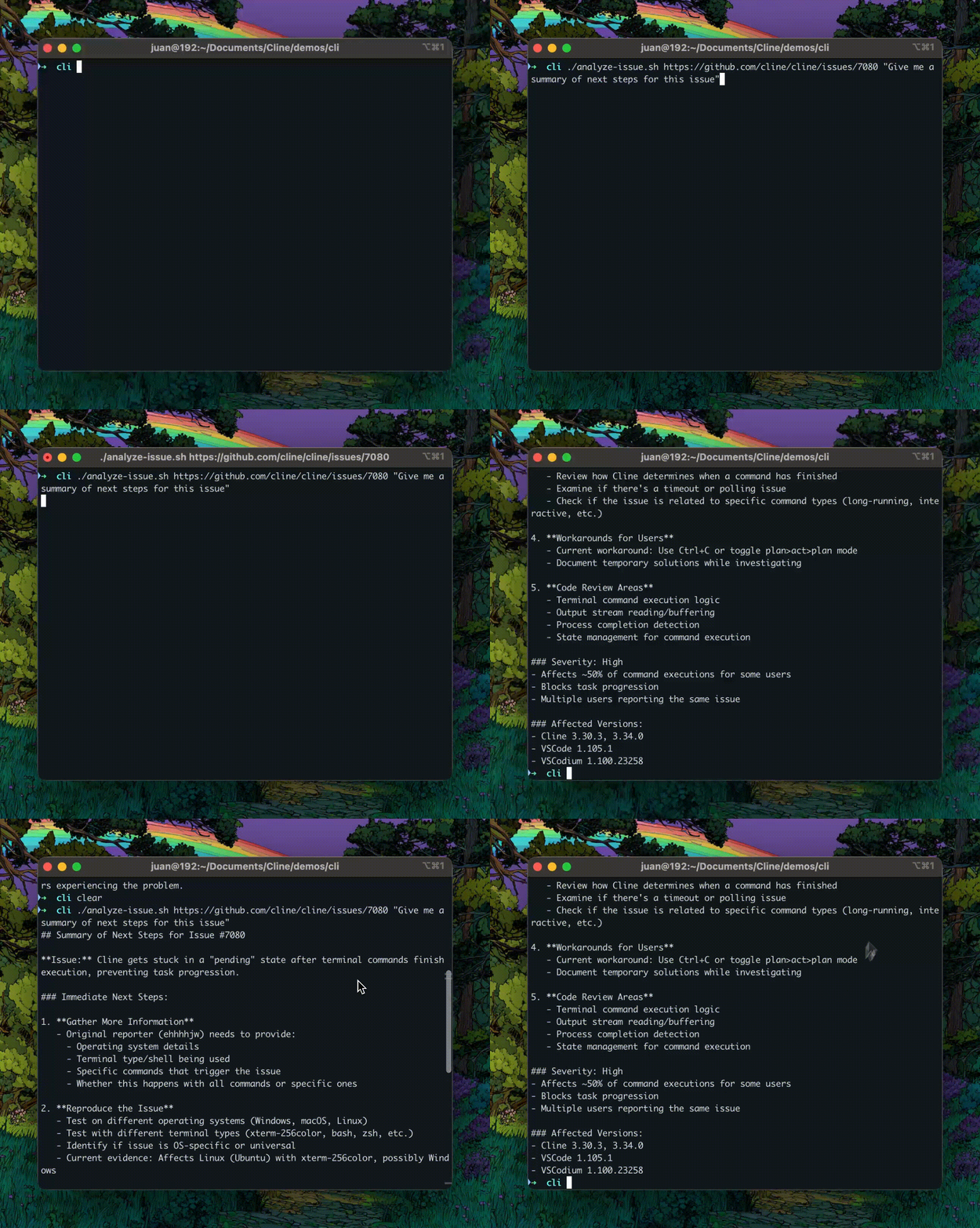
Automated GitHub issue analysis using Cline CLI to identify root causes.
Automated GitHub issue analysis using Cline CLI. This script uses Cline’s autonomous AI capabilities to fetch, analyze, and identify root causes of GitHub issues, outputting clean, parseable results that can be easily integrated into your development workflows.
New to Cline CLI? This sample assumes you have already completed the Installation Guide and authenticated with cline auth. If you haven’t set up Cline CLI yet, please start there first.
Click to view the complete analyze-issue.sh script
#!/bin/bash# Analyze a GitHub issue using Cline CLIif [ -z "$1" ]; then echo "Usage: $0 <github-issue-url> [prompt] [address]" echo "Example: $0 https://github.com/owner/repo/issues/123" echo "Example: $0 https://github.com/owner/repo/issues/123 'What is the root cause of this issue?'" echo "Example: $0 https://github.com/owner/repo/issues/123 'What is the root cause of this issue?' 127.0.0.1:46529" exit 1fi# Gather the argsISSUE_URL="$1"PROMPT="${2:-What is the root cause of this issue?}"if [ -n "$3" ]; then ADDRESS="--address $3"fi# Ask Cline for its analysis, showing only the summarycline -y "$PROMPT: $ISSUE_URL" --mode act $ADDRESS -F json | \ sed -n '/^{/,$p' | \ jq -r 'select(.say == "completion_result") | .text' | \ sed 's/\\n/\n/g'
After downloading or creating the script, make it executable by running:
./analyze-issue.sh https://github.com/owner/repo/issues/123 \
    "What is the root cause of this issue?" \
    127.0.0.1:46529
This is useful when:
Running multiple Cline instances
Using a remote Cline server
Testing with specific configurations
The script will automatically handle everything: fetching the issue, analyzing it with Cline, and displaying the results. The analysis typically takes 30-60 seconds depending on the issue complexity.
**Root Cause Analysis of Issue #2: "setState isn't cutting it"**After examining the GitHub issue and analyzing the Flutter counter codebase, I've identified the root cause of why setState() is insufficient for this project's needs:## Current Implementation ProblemsThe current Flutter counter app uses setState() for state management, which has several limitations:1. **Local State Only**: setState() only works within a single widget, making it difficult to share state across the app2. **Rebuild Overhead**: Every setState() call rebuilds the entire widget tree, causing performance issues with complex UIs3. **No State Persistence**: State is lost when the widget is disposed4. **Testing Challenges**: setState-based logic is tightly coupled to the UI, making unit testing difficult## Why This MattersAs the app grows beyond a simple counter, these limitations become critical:- Multiple screens need to access the count- State needs to persist across navigation- Business logic should be testable independently- UI should only rebuild when necessary## Recommended SolutionsThe issue mentions "Provider or Bloc" - both are excellent alternatives:1. **Provider**: Simple, lightweight state management using InheritedWidget - Easy migration path from setState - Good for small to medium apps - Official Flutter recommendation2. **Bloc**: More structured approach with clear separation between events, states, and business logic - Better for complex apps - Excellent testability - Clear architectural patterns3. **Riverpod**: Modern alternative to Provider with better performance and developer experience - Compile-time safety - Better testing support - More flexible than Provider4. **GetX**: Full-featured solution with state management, routing, and dependency injection - Minimal boilerplate - Fast and lightweight - All-in-one solution## Next StepsThe current codebase needs refactoring to implement proper state management architecture to handle more complex state scenarios effectively. Provider would be the easiest migration path while Bloc provides better long-term scalability.